

Nenagh Hospital suffering from knock-on effects of crisis at Limerick facility
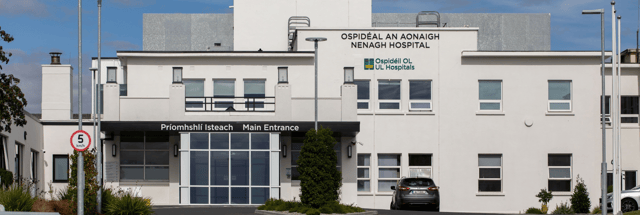

The crisis at the Emergency Department in University Hospital Limerick has begun to have a knock-on effect on services at Nenagh Hospital.
Limerick caters for a huge catchment area in north Tipperary, with patients from as afar afield as Lorrha and Thurles using the facility.
With the winter surge well underway, hospital services have been hit by a combination of an increase in Covid and seasonal flu patients, as well as the rise in respiratory syncytial virus (RSV), coupled with staff shortages through illness.
As of this Tuesday there were eight Whole Time Equivalent (WTE) staff absent from Nenagh Hospital through Covid and sick leave. Under the normal complement, there are 19 medics (excluding consultants who work across multiple sites in UL Hospitals Group), and 159 nursing staff at Nenagh Hospital, according to a spokesperson for UHLG.
As of this Tuesday morning there were eight patients on trolleys in wards waiting for a bed. There were 44 on trolleys in Limerick, with 22 in ED and 22 waiting in wards. A further 10 patients were waiting on beds in Tipperary University Hospital.
Nenagh Hospital can cater for 64 bed patients, and since January 2, Hospital has been providing up to 12 surge beds.
The biggest impact of the current situation in Limerick has been the deferral of planned resumption of day surgery at Nenagh Hospital from Monday, January 9. All those affected were contacted by hospital staff and their surgery rescheduled, according to a spokesperson from University Hospital Limerick Group.
The spokesperson said that the surgical day ward in Nenagh Hospital was currently open as surge capacity for inpatients as they managed high volumes of unwell medical patients across all hospitals in the Mid West, largely driven by a wave of respiratory illnesses in the community.
The decision to defer day surgery in what are termed model 2 hospitals, including Nenagh, was due to be reviewed by the Hospital Crisis Management Team this week.
Many trace the origins of the chaos back to the decision by the Fianna Fáil Government to implement the Hanly Report on the reconfiguration of hospital care in the Mid West, which was published in 2008.
Its decision to close ED in Nenagh, Ennis and St John’s in Limerick was greeted with protests on the streets and dire warnings from medics and some local politicians.
Promised investment was not delivered and the model was based on a population almost one third less than currently in the Mid West.
The present situation has been condemned this week by some Tipperary TDs and one local councillor.
Nenagh TD Alan Kelly said that he had been raising the issue of hospital care in the Mid West throughout his political career, but what was happening currently was a “travesty for the people of Tipperary, Clare and Limerick” that was entirely predictable given what we have come through over the last few years.
“The historical decision to create a centre of excellence in UHL for cancer care and other disciplines was not the wrong one,” he said. “The decision to close local A&Es and critical care units before the total infrastructure was in place in UHL, and, indeed, across the hospital network of UHL, Nenagh, Ennis and St John’s was.”
Deputy Kelly said that he had warned of this at the time and we were all now paying for this.
“It is not acceptable. We in the Mid West were the guinea pigs for testing HSE reconfiguration for the rest of the country. We were sold a pup. It has not worked,” he declared.
“This is no reflection on staff and management across the network who have been working all hours to make something work that just can’t because the area covered in the Mid West is just too big for a hospital network conformed the way it currently is,” said the Labour TD.
He pointed out that UHL had less consultants, staff and beds pro rata than other similar size hospitals.
In the long term, the Mid West needed more capacity, more beds, more consultants, more staff and more transportation. This was plainly obvious, he said.
Independent TD Michael Lowry said that the decision to allow ambulance staff bring patients directly to the Medical assessment Unit at Ennis Hospital, which began this Monday, was “a clear indication that removing A&E services at Nenagh, Ennis and St John’s in Limerick in 2009 was a mistake”.
“Since the ill-advised and strongly opposed downgrading to Model 2 status of Nenagh, Ennis and St John’s Hospitals’ in 2009, the Centre of Excellence Model 4 University Hospital Limerick has provided the only 24-hour A&E service for the entire population of Limerick city and county, north Tipperary and Clare,” he pointed out.
While acknowledging that the full extent of the Christmas and New Year A&E crisis had exceeded the worst fears, Deputy Lowry said that there had been numerous warnings that demands on hospitals over the winter months would likely surpass anything seen in the past.
Deputy Jackie Cahill welcomed the decision to reopen Ennis, and said that this proved hat such a move was also possible in Nenagh.
Meanwhile, Independent councillor Seamus Morris said local TDs were remaining “tightlipped” over the crisis because they had all bought into the privatisation of public services.
“The incredible suffering inflicted on our hospital-going public (and their workers) has been plotted for a long time by several Governments, aided and abetted by most, if not all, our TDs in the Mid West. That’s why they are hiding at the moment," said Cllr Morris.