

Tipperary minors hope to continue winning streak in All-Ireland final
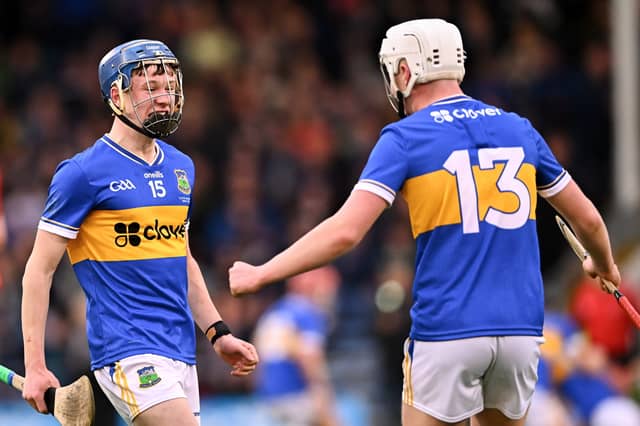

Best sides in the competition are in the final for a game that holds much promise
The All-Ireland minor hurling roll of honour is headed by Tipperary. Since the competition began in the late 1920s the county has collected 22 titles, ahead of Kilkenny on 21 and Cork with 20. Limerick have a meagre three wins, the last in 1984.
For Tipperary there’s a chance to extend their lead on Saturday when we head to the Gaelic Grounds for a showdown with the locals in what will be the third meeting of the teams in the current championship. Two wins already for Tipperary over the neighbours is no guarantee of success on Saturday, but we’ll certainly hope the winning streak continues.
Whatever happens, this Tipperary team has so far entertained and enthralled followers with the quality of their play. There’s an attacking flair to the side that has been a signature feature all season. So far, they’ve hit 19 goals in six games with players like Conall Morrisson and Chris Dunne spearheading that forward division. In the Munster final it was Morrisson who excelled, hitting 2-4; Dunne was the star turn in the All-Ireland semi with a personal 3-5.
For their part Limerick have been more of a slow burn in the competition, starting with a disappointing home defeat to Waterford. Thereafter they worked their way back into the reckoning. They turned over Clare in Ennis before losing to Tipperary and then rallying their season with a rousing win over Cork at Páirc Uí Chaoimh.
Even the Munster final defeat failed to deter the Shannonsiders. They got back on the horse with a strong win over Clare in the All-Ireland quarter-final before crushing Galway in the semi. Undeniably, the two best sides in the competition are in the final for a game that holds much promise.
I assume (always dangerous) that this is the first time-ever to have minor finalists meeting for the third time in a single championship. We have precedent for meeting Limerick twice in the same season. It happened back in 2016 when Liam Cahill was building his managerial career.
The teams first met in the Munster final, where Tipperary steamrolled Limerick by a 14-point margin. It was altogether tighter when there was a rematch in the All-Ireland decider. This time Tipperary won by just seven points. Jake Morris got a crucial goal and Colin English (Fr. Sheehy’s) was man of the match. Brian McGrath captained the side from centre back.
Jake Morris was the standout player from that bunch to progress to senior stardom. Others progressed too but to a lesser extent. Conor Stakelum came on as a replacement in that 2016 final - as did the late Dillon Quirke. Jerome Cahill was an exciting prospect at wing back; Paddy Cadell and Ger Browne were midfield; and Mark Kehoe (where is he now?) was corner forward.
Such name-dropping highlights how few minors – even successful All-Ireland-winning minors – ultimately make the highest grade. It’s a steep climb and very few make the summit.
Arguably, Limerick got more from their losing side. Four-time All-Star winner, Kyle Hayes, was full forward on that minor team and two-time All-Star Barry Nash was corner back. Conor Boylan was another subsequent All-Ireland winner to feature on that 2016 Limerick minor side.
Anyway, Saturday’s final is high on promise. There was a significant gap between the teams back in 2016 but ten years later matters are much tighter. The Munster final illustrates the point. There was little between the sides that night in Thurles. Goals won it for Tipperary. We had two in the bag by half time from Conall Morrisson and K.J. Dunne and Morrisson’s second late in the day sealed the win, as the visitors went goal-less.
Behind that goal-less tag is a revealing story. One of the Tipperary goals was a giveaway when the Limerick ‘keeper was unfortunate to drop the ball over his own line. Then they had a goal disallowed for a “square” infringement – a correct call but it might easily have been missed. Finally, Eoin Connolly made a brave, point-blank save in the second half to secure his clean sheet.
Altogether, that’s a potential turnover of nine points, though things are never quite as logical as that in the chaos of an unfolding game. A Limerick goal at any stage would have changed the dynamics of the match and there’s no knowing how players might have reacted in such circumstances.
Still, all the evidence suggests there’s not a lot between these teams, so form on the day will decide the destination of the Irish Press Cup. We wish James Woodlock and the gang every success.
Elsewhere, the All-Ireland hurling quarter-finals did little to enhance the image of hurling. Two one-sided games, lacking quality and creating controversy, will have been dissected for all the wrong reasons. Leinster hurling took another bashing as Dublin and Offaly limped off into the Thurles sunset. Galway alone can now save the reputation of the eastern province.
Cork’s crushing of Offaly was no surprise. This used to be the fate of McDonagh Cup finalists but now the malaise has extended to Leinster qualifiers. Offaly have made progress, for sure, in recent years but an experience like this only illustrates just how far they still have to travel in order to be competitive against the top teams.
Unfortunately for the midlanders, Cork are the type of side that will ruthlessly expose you if you’re off the pace. The naivety of some of the Offaly defending against the goal-rush was, at times, pitiful. Much better equipped teams worry about curbing the Cork goal threat yet Offaly seemed oblivious to it, judging by the lack of defensive cover. Once the floodgates open, seventy minutes can feel like an eternity of torture.
And we could do without the trite commentary that this is a learning curve for Offaly. You learn nothing of value from a pummelling like this. All it does is lay bare your inadequacies, which undoes any progress and sets you back years.
Clare, for their part, will head into an All-Ireland semi-final feeling very unsure about their whereabouts following their big win over Dublin. There’s a backstory behind the scoreboard tally. They won by 13 points, which should indicate an easy ride for their goalie. Yet he was man of the match after pulling off a string of outstanding saves. Unspool that riddle if you can.
Clare were economical, for sure, with their scoring chances but their defence was carved open repeatedly. Quilligan resembled the Dutch boy with his finger in the dam. Seldom has one man held the waves at bay so valiantly. Another porous performance like that against Limerick and their season is history.
Sadly, the game had its controversial ending with that dangerous tackle on David Reidy, which saw the game held up for a prolonged period. Dublin’s Brendan Kenny was rightly red-carded. Thankfully there was positive news on the Clare man later but hopefully the event will prove a catalyst for change.
All robust field games are having to address the issue of head injuries but the GAA has been slow on this area of enforcement. There’s too much ambiguity. If there’s a consistent policy of red cards for all head-high tackles then players will quickly learn. And the lesson may be painful when your own offend. In Tipperary, for instance, we’ll have to acknowledge that Willie Connors’ tackle on Mark Rodgers this year was a red card offence too.
All of this, of course, is against the backdrop of a tough-man subculture in hurling. So, we need to face down garbage talk about taking manliness out of the game and helmets being the answer to hits on the head. Sadly, there’s an audience out there for such dangerous bravado but it needs to be tackled head-on, if you’ll excuse the pun.
Some claim hurling rules don’t need to be tinkered with. They’re right. Hurling needs a wholescale football-style review. Over to you John Meyler.