

McEntee visits peacekeepers and says ‘destruction in Lebanon just like in Gaza’
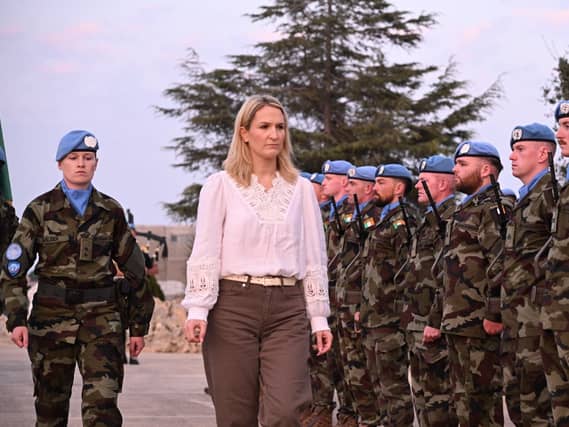

The Defence Minister has likened the devastation in southern Lebanon to an ‘earthquake’.
The Defence Minister has likened destruction in southern Lebanon to an “earthquake”, as she said experience from Gaza shows the need for a continued monitoring presence in the region.
Helen McEntee visited Irish troops serving with the United Nations Interim Force in Lebanon (Unifil) on Monday, as the mission prepares to unwind after the UN Security Council did not approve its continuation.
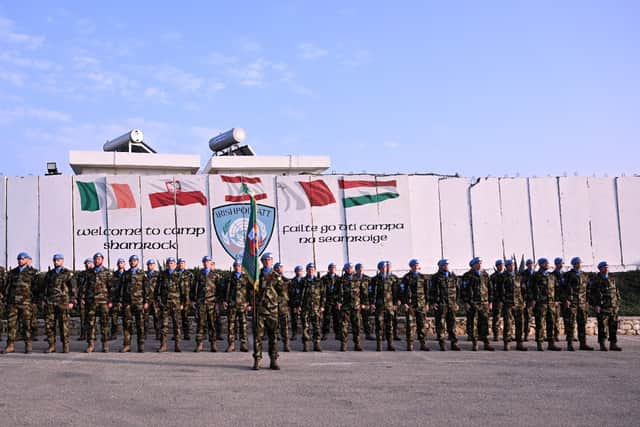
Ms McEntee said United Nations Position 2-45, known as Camp Shamrock, is now “surrounded” by the Israel Defence Forces (IDF) which have established new outposts where the Lebanese armed forces would have been.
Speaking from the base to reporters in Ireland, the Minister said: “With Unifil coming to an end, the presence here specifically will most likely come to an end.
“And I think for me, that’s the biggest challenge because what we’re seeing here is exactly what we’ve seen happen in Gaza.
“When you have nobody on the ground to be able to monitor and to report back what’s happening, you have no idea what’s happening here and we know that is the case in Gaza at the moment.”
Describing her journey from Unifil headquarters in Beirut to Camp Shamrock, she said: “The only way I can describe it is that it looks as though everywhere has been hit by an earthquake – only it’s not an earthquake.
“Every single village that we pass through, bar one, has been completely demolished.
“So every house, every building standing, any car has been demolished and there’s just no sign of life – which is pretty devastating.”
Further reflecting on the journey through the mostly Shia Muslim population centres in the Irish area of operations, she added: “Any of the villages that we did pass through, where there’s people there, they’re the Christian villages.
“And while they haven’t been impacted in the same way, from the brief here that I’ve been given, those towns have have also diminished in population.
“And you have people there that are very scared, because while our troops are here, they’re able to document what’s happened but when Unifil moves out, you have a number of communities that are left here and you have absolutely no ability to see what the IDF is doing.”
Ms McEntee said the towns and villages “will find it very difficult to ever be built back up again”.
Much of the conversation in Ireland around the wind down of the Unifil mission has focused on Government plans to reform the triple lock mechanism for overseas deployments, with the minister stating there was a need to ensure Ireland continued to have a presence in Lebanon.
Under the current system, Ireland cannot deploy any more than 12 troops overseas without a mission being approved by the UN, as well as approval by the Government and the Dáil.
The Government is proposing to remove the requirement for formal UN approval and replace it with a stipulation that the deployments are in accordance with the UN Charter.
The Government argues this will prevent the five permanent members of the Security Council: Russia, China, the UK, the US and France; from exercising their veto against Irish peacekeeping missions such as Unifil.
Critics see the move as an effort to remove the core protections of the triple lock, erode Ireland’s long-standing policy of neutrality and practically align with Nato.
They have also contended that the current system allows the UN General Assembly to approve such a mission in the absence of a green light from the Security Council.
The Bill also includes draft proposals to amend provisions relating to the deployment of Defence Forces personnel in non-combatant evacuation operations and “peace enforcement”.
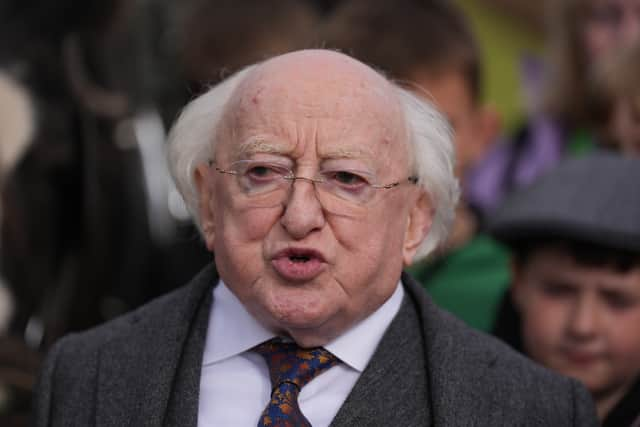
Asked about warnings from former president Michael D Higgins that Ireland is moving towards military alliances, Ms McEntee said: “There’s a lot of rhetoric and there’s a lot of suggestions that we’re going to be forcing people to do things, that we’re going to be forcing our troops to go places.
“This will always remain Ireland’s choice.”
She added: “What will change is that we won’t find ourselves in a situation where five countries that have a permanent veto on the UN Security Council could potentially dictate that we have to be removed from a position that already we’ve given approval for at a Government level.”
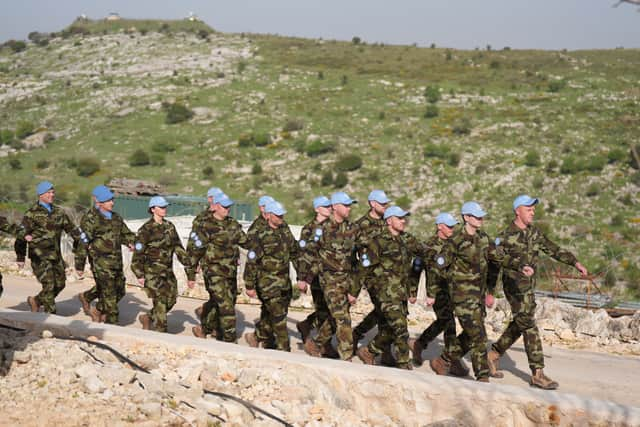
While Unifil, which has a peacekeeping mandate, is winding down, the EU has proposed the establishment of a mission to support the Lebanese armed forces.
Asked if she accepted joining that mission would mark a shift in Ireland’s stance from peacekeeping to peace enforcement in Lebanon, Ms McEntee said Irish troops have already been deployed for peace enforcement elsewhere.
She said: “It’s about being able to make a choice as to what works for us as a country and what do we want to contribute to.
“It’s not the case that we’re going to be required to join any EU mission, we’ve always made that decision ourselves.
“But what’s happening with the triple lock now is, where we have troops on the ground involved in missions now no longer able to stay and contribute in the same way because of decisions of other countries – and that is what it boils down to – our position of neutrality is not going to change.”
The minister was also involved in a a medal parade for members of the 128th Infantry Battalion, recognising their service and dedication during a “particularly challenging period” for the UN mission.
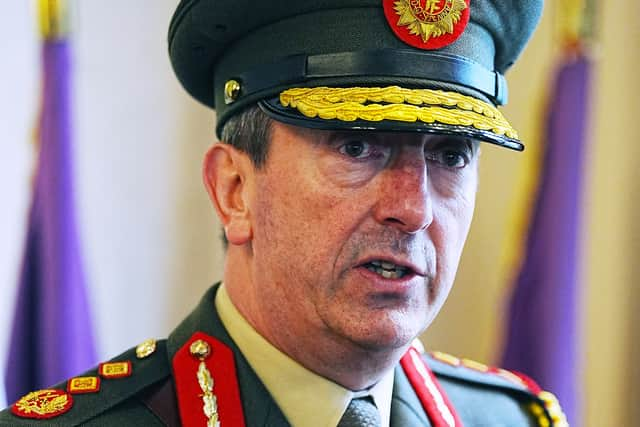
Chief of Staff Lieutenant General Rossa Mulcahy said: “The conditions under which our troops are operating in is difficult, it’s challenging, but they are well capable, they’re well trained, and they have the equipment and the abilities to conduct their mission here in a challenging environment.”
He added: “We are preparing now for the next battalion, who will come out in in the next couple of weeks, the 69th Infantry Group, and they will then commence the planning and the execution of the drawdown of our equipment and our personnel in early 2027.”
Lt Gen Mulcahy said the withdrawal will be followed by an opportunity to “reset” and consider options available for future missions.
He said: “I would be confident that we will find something there in 2027 or 2028.”
Possible avenues for further missions include continued participation in Bosnia or Kosovo.
“We’re exploring what are the potential options coming in the next 12-18 months, and I’ll make recommendations to the department and the minister, and then that’s for a Government decision as to whether Defence Forces in Ireland participates in a new form in some of those missions.”