

OPINION: After Amaggedon, someone still needs to milk the cows

This week, Katie reflects on all things end-of-the-world, where self-sufficiency is all well and good, but ultimately nothing without community and solidarity
It has been said that life imitates art.
I was halfway through writing this column about emergency preparedness, cyberattacks and the fragility of modern infrastructure when the electricity went off. You couldn't make it. With my laptop battery fading fast, I found myself racing to finish a column about emergency preparedness by candlelight. The irony wasn't entirely lost on me.
A few weeks ago, the Government sent out 2.2 million emergency preparedness booklets. I never received mine. Perhaps somebody in the Department spotted the dairy farm address and decided we were sufficiently experienced in dealing with calamities. As it turns out, they may have had a point.
Humanity has spent centuries anticipating some kind of impending doom. What changes is our preferred flavour of disaster. In 1962, American magazine Esquire identified nine places where people might survive nuclear war. Among them was County Cork, apparently thanks to its geography, prevailing winds and food-producing potential. I imagine the ever humble people of Cork were delighted to receive scientific confirmation of something they'd suspected all along.
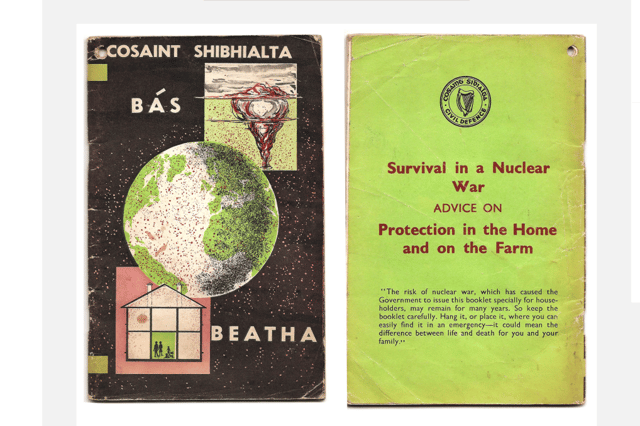
Three years later, the Irish Government published a nuclear survival handbook called Bás Beatha, meaning Death and Life, complete with a mushroom cloud on the cover. In fairness, nothing says reassurance quite like a radioactive explosion. The handbook even included advice on protecting livestock. Apparently, somebody would still have to milk the cows after Armageddon.
By 1999, our impending doom had become digital. The Millennium Bug threatened computer systems unable to distinguish 2000 from 1900. Governments and businesses spent fortunes fixing the problem. Then, in 2002, the Government distributed 12.6 million iodine tablets in case of a nuclear accident. I suspect some are still sitting in kitchen drawers beside expired batteries and a half-charged Nokia 3210.
Fast forward to recent months and across Europe, governments are encouraging households to prepare for emergencies. The European Commission recommends being able to manage independently for 72 hours. The UK has launched its Be Ready campaign, while Nordic countries have long promoted household preparedness. Ireland originally considered the same 72-hour message but dropped it after focus groups worried it might frighten people.
Which is wonderfully Irish. We want to be warned about impending disaster, just preferably without anyone alarming us. Given recent events, perhaps the advice isn't so peculiar.
We've had bomb hoaxes disrupting flights, RTÉ evacuated, threatening emails sent to schools and hackers interfering with refrigeration systems in SuperValu supermarkets. We've reached a stage of technological advancement when even the frozen peas require cybersecurity. Then on Friday, Microsoft services went down, disrupting Outlook and other systems. Across the Atlantic, American flights were grounded following technical problems.
My tinfoil remains firmly in the press: not every disruption is a cyberattack, nor are these incidents necessarily connected. But they demonstrate how dependent we've become on systems most of us neither understand nor control. We've made everything faster, smarter and more convenient. Whether we've made it more resilient is another question.
Of course, there's nothing foolish about keeping emergency supplies. A torch, batteries and a few tins of food are sensible precautions. What interests me more is our tendency to think of preparedness as something we do individually. Disaster research repeatedly challenges the Hollywood image of people descending into selfish panic. In reality, cooperation and support are the key. We saw that during Storm Éowyn, when neighbours shared generators, checked on vulnerable residents and opened community facilities.
Which raises a question in my mind, Why are we so concerned with making individual households resilient while allowing the places that make communities resilient: local shops, post offices, pubs and community centres to disappear? A community centre might not look like critical infrastructure until the day it becomes somewhere to charge a phone, get warm or find help.
While it's sensible to prepare for a few days without essential services, we shouldn't confuse household self-sufficiency with a whole community's ability to recover. You can stockpile food, water and batteries, but you can't stockpile trust, goodwill or a neighbour who knows how to fix a generator. We've spent thousands of years surviving through cooperation. It would be foolish to forget that now.
This evening I didn’t look for a booklet: I looked out the window to my neighbours, turned on the radio and checked social media for news. Preparedness should be as much about knowing the people next door as knowing what's in the kitchen cupboard, because when things go wrong, it's not always what you have that makes the difference, but who you have.