

Mass to be held in Tipperary to honour over 1,400 World War 1 dead and memory of Fr Willie Doyle
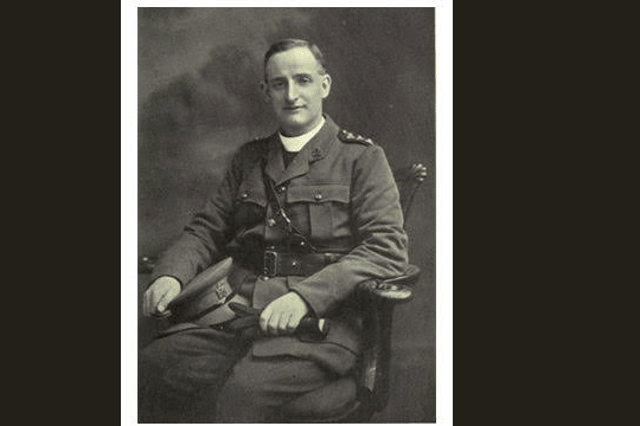

A Mass will be celebrated in the Cathedral of the Assumption in Thurles on Monday, 23rd November at 2.00pm in remembrance of Fr Willie Doyle and the local 1,400 Tipperary men who died in the First World War.
The following has been submitted by Patrick Blake
A Mass will be celebrated in the Cathedral of the Assumption in Thurles on Monday, 23rd November at 2.00pm in remembrance of Fr Willie Doyle and the local 1,400 Tipperary men who died in the First World War.
Fr Willie Doyle died at Langemarck , near Frezenberg , Belgium in 1917 trying to drag wounded men from no-man's land. He was 44, a Jesuit from Dalkey, and one of the most decorated chaplains of the First World War.
Fr Willie Doyle was 42 when war broke out, a Jesuit priest in his prime, famous in Ireland for giving retreats to working men and for writing pamphlets on vocations that sold in their thousands. He could have stayed in Dublin. He volunteered instead.
In November 1915 he landed in France as chaplain to the 8th Battalion, Royal Irish Fusiliers, part of the 16th (Irish) Division. He stayed with them through the Somme, through Messines, through Ypres, until a shell killed him on 16 August 1917 at Langemarck.
He was, by any measure, an unlikely soldier. Small, short-sighted, intensely shy, a man who had spent his life in prayer and who kept a private diary of his sacrifices. He recorded in that diary the small mortifications he offered each day. He gave up sugar in his tea. He gave up butter. One famous entry, later quoted by St Josemaria Escriva, reads simply: "Didn't take butter...; did take butter!"
That same man became, in the words of his commanding officer, "one of the bravest men I ever met."
William Joseph Gabriel Doyle was born in Dalkey, Co Dublin, on 3 March 1873, the youngest of seven children. He was educated at Ratcliffe College in England, entered the Jesuits in 1891, and taught at Clongowes Wood College and Belvedere College. He was ordained in 1907.
After ordination he became convinced that the Spiritual Exercises of St Ignatius should not be kept for priests and nuns alone. He wanted working men to make retreats. In 1909 he published a pamphlet, “Retreats for Working Men: Why Not in Ireland?” It was a radical idea at the time. He travelled the country giving missions, sleeping on floors, hearing confessions until midnight.
When war came, he saw it as a new mission field. He wrote to his father: "I feel I must go. These poor boys will need a priest out there more than anywhere else."
Fr Willie did what chaplains were supposed to do, and then he did far more. He said Mass in dugouts with a packing case for an altar. He heard confessions in trenches while shells fell. He wrote letters home for dying men who could not hold a pencil. He buried the dead, often under fire, marking the graves with a rifle stuck in the mud and a helmet on top. And he went out, again and again, into no-man's land to bring in the wounded. His letters home, now collected in Dr. Patrick Kenny's book “To Raise the Fallen”, are extraordinary because they are so ordinary. He does not boast. He jokes about the mud. He worries about his men.
On 8 August 1917, eight days before he died, he wrote: "I have been through a lot these last days, but God has been very good to me. I have been able to help many a poor fellow to die in peace."On another occasion, after carrying a wounded man for two hours, he wrote: "I was so tired I could scarcely stand, but what a joy to know that I had saved a soul, perhaps a life."
The reason the soldiers had so much respect and admiration for him was because he never asked them to go where he would not go himself. He refused to stay behind the lines. He ate what they ate. He slept where they slept. He ran with the stretcher bearers. When a man was hit, Doyle was often the first man to reach him, not because it was his job, but because he could not bear to leave him alone. One officer wrote after his death: "The men would follow Father Doyle anywhere. He never preached at them. He just lived beside them. Another, a Protestant officer who had no time for priests, said: "Doyle was a saint. There was no other word for him. He feared nothing." He was awarded the Military Cross in 1917 for bravery at Messines. He was recommended for the Victoria Cross, but as a chaplain he could not receive it. He did not care about medals. He cared for his men and his men cared that he was there for them.
Fr Willie Doyle died on the first day of the Battle of Langemarck , part of the Third Battle of Ypres, Passchendaele. The ground was a sea of mud. Men literally drowned in shell holes. He had spent the days before the battle moving up and down the line , hearing confessions and giving Holy Communion to men who knew what was coming. The morning of the battle was spent giving absolution and anointing the dying. In the afternoon he saw two wounded men lying in the open. He ran out to them. A shell burst beside him. He was killed instantly. He was 44. His body was recovered, then obliterated by a second shell. He has no grave. His name is on the Tyne Cot Memorial.
His death was one of millions. The First World War, ‘the war that was to end all wars’, killed more than 10 million soldiers. Ireland lost an estimated 35,000 men. Tipperary alone lost around 1,400. They were not just numbers. They were human beings, mothers, sons , fathers , boyfriends, farm labourers from Thurles, shop assistants from Nenagh, schoolboys from Clonmel who had lied about their age in order to qualify to enlist.. Many signed up in 1914 and 1915 with romantic notions. Many in their youthfulness and innocence thought it would be over by Christmas. They thought it would be an adventure. Two friends from Littleton joined because they thought they would be in the cavalry and have their own horses just like in the films. After joining they were separated and never met again until years later when the war was long over. They went in groups, whole streets, whole football teams, whole schools going together. They believed they were fighting for small nations, for Ireland, for home, for God. They believed their sacrifice would mean something. What they found was industrial slaughter. Machine guns, poison gas, barbed wire, mud that swallowed men alive. They stayed anyway. They stayed for each other.
When the survivors came home, Ireland had changed. The Rising, the War of Independence, the Civil War, made it hard to talk about men who had fought in a British uniform. For decades their sacrifice was not recognised, not appreciated, not even remembered in many towns. Families kept medals in drawers. Names faded from memorials. Men who had seen hell at the Somme were told not to talk about it . Many suffered from undiagnosed and untreated post traumatic stress syndrome while some spent the rest of their lives walking the roads of Ireland never able to settle in any one place for any length of time.
A Mass will be celebrated in the Cathedral of the Assumption in Thurles on Monday, 23rd November at 2.00pm in remembrance of Fr Willie Doyle and the local 1,400 Tipperary men who died in the First World War. It is for every Tipperary man whose name is on a village memorial, or on no memorial at all. It is for the boy who enlisted at 17 because his friends did. For the father who never saw his child grow up. For the priest who ran towards the guns because he could not leave his men alone in the mud.
We cannot bring them back but we can , if we wish, remember them and pray for their departed souls particularly during this November , the month of the Holy Souls. We can recall at least some of their names , in Thurles, in their own county, at last . We can also pray that such an appalling loss of life , such carnage and devastation will never again visited upon the youths and men of our parishes , our county and our country.
Fr Willie Doyle’s cause for canonisation has now gone to Rome.
May they all rest in peace.